AI Is Changing Fresher Hiring in India in 2026: Skills, Jobs & What Students Need to Learn
AI is reshaping fresher hiring in India in 2026. Explore the skills employers increasingly value, emerging AI roles, hiring trends, and what students can learn to stay career-ready.
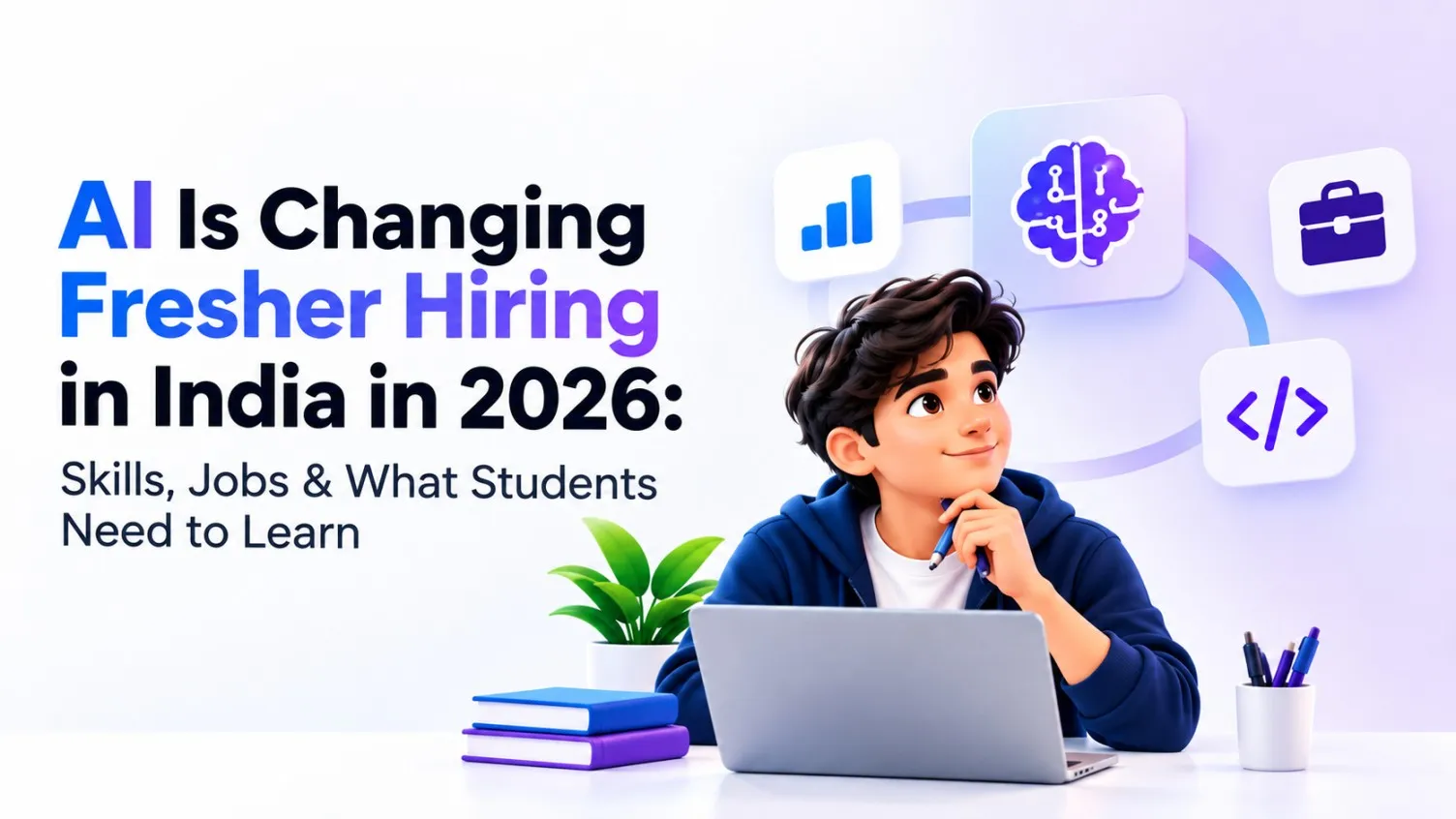
AI Is Changing Fresher Hiring in India in 2026: Skills, Jobs & What Students Need to Learn
Artificial intelligence is no longer only a technology trend for experienced engineers. It is increasingly influencing how companies hire, what skills they look for, and which entry-level roles are emerging in India.
Recent hiring data shows that AI and machine learning demand is growing even while broader technology hiring remains more selective. Naukri JobSpeak's September 2026 data reported a 20% year-over-year increase in AI/ML hiring, while AI/ML fresher hiring increased 19%. Overall fresher hiring grew by only 1% during the same period.
Deloitte India's 2026 Campus Workforce Trends research also found that 35% of organizations reported that AI adoption is creating new entry-level roles or skill requirements, compared with 21% in FY25.
For students and fresh graduates, this does not mean everyone needs to become a machine learning engineer.
It means the skills expected from early-career technology candidates are changing.
How AI Is Changing Fresher Hiring
The traditional fresher hiring model often focused heavily on:
- Academic qualifications
- Aptitude tests
- Programming fundamentals
- Communication
- Technical interviews
Those fundamentals still matter.
However, employers are increasingly looking for candidates who can demonstrate practical skills around AI, data, automation, and modern software development.
Deloitte India's 2026 research reports that AI and Agentic AI are transforming recruitment processes. Among surveyed organizations, 72% use AI for resume screening, 48% for AI-based assessments, 37% for candidate engagement, and 33% for predictive hiring.
This creates two changes for freshers:
- AI is becoming part of the jobs they apply for.
- AI is increasingly becoming part of the hiring process itself.
AI/ML Hiring Is Growing
The latest Naukri JobSpeak figures show a significant difference between AI/ML hiring and broader IT hiring.
| Hiring Area | September 2026 YoY Change |
|---|---|
| Overall white-collar hiring | +2% |
| AI/ML hiring | +20% |
| AI/ML fresher hiring | +19% |
| IT & Software Services hiring | -4% |
| Overall fresher hiring | +1% |
The data indicates that hiring growth is not evenly distributed across technology.
AI/ML is one of the areas showing stronger demand, while broader IT and software services hiring remained weaker.
For freshers, this makes specialized skills increasingly relevant.
What Does This Mean for Freshers?
The most important point is that AI skills are becoming an additional layer on top of software and technical fundamentals.
A student does not necessarily need to choose between software development and AI.
Instead, these skills can complement each other.
For example:
| Existing Skill | AI Extension |
|---|---|
| React | AI-powered web applications |
| Node.js | AI APIs and backend services |
| Python | Machine learning and AI applications |
| SQL | Data analytics and AI data pipelines |
| Cloud | AI deployment and infrastructure |
| Cybersecurity | AI-assisted security systems |
| Data Analysis | Machine learning and predictive analytics |
This combination can create more practical career options than learning AI concepts in isolation.
The AI Skills Freshers Should Learn
1. Python
Python is a useful starting point for students interested in AI, machine learning, automation, and data.
Important areas include:
- Variables and data types
- Functions
- Object-oriented programming
- File handling
- Exception handling
- Modules and packages
- APIs
- Testing
You do not need to master every Python library before starting AI.
Build a strong programming foundation first.
2. SQL and Data
AI systems depend on data, which makes database knowledge valuable.
Freshers should understand:
- SELECT queries
- Filtering
- Sorting
- Joins
- Aggregations
- Subqueries
- Data cleaning
- Database fundamentals
A candidate who understands both AI concepts and the data behind them can build more useful applications.
3. Machine Learning Fundamentals
Students interested in ML should understand the basic concepts before moving into advanced frameworks.
Start with:
- Supervised learning
- Unsupervised learning
- Classification
- Regression
- Clustering
- Feature engineering
- Model evaluation
- Training and testing
- Overfitting
The goal should be understanding how models work rather than simply importing a library and calling a function.
4. Generative AI
Generative AI has become an important part of modern software development.
Freshers can explore:
- Large language models
- Prompt engineering
- AI APIs
- Embeddings
- Vector databases
- Retrieval-Augmented Generation
- Tool calling
- AI agents
But simply knowing how to write prompts is not enough.
Try building applications that solve actual problems.
5. APIs and Backend Development
AI applications frequently need to communicate with databases, external services, and frontend applications.
Understanding APIs can therefore be highly useful.
Learn:
- REST APIs
- HTTP methods
- JSON
- Authentication
- API integration
- Error handling
- Backend frameworks
A developer who can connect an AI model to a complete application can demonstrate practical engineering ability.
6. Cloud Fundamentals
AI applications increasingly depend on cloud infrastructure.
Freshers should understand concepts such as:
- Compute
- Storage
- Databases
- Containers
- Deployment
- Serverless services
- Monitoring
- Basic cloud security
You do not need to learn every cloud service.
Start with the fundamentals and deploy real projects.
7. Git and GitHub
AI skills need to be supported by normal software engineering practices.
Learn how to:
- Create repositories
- Create branches
- Commit changes
- Manage pull requests
- Resolve conflicts
- Write useful README files
- Collaborate with other developers
Your GitHub profile can also provide evidence of what you have actually built.
AI Skills Are Not Enough by Themselves
The growth in AI hiring should not be interpreted as the end of traditional software engineering.
AI applications still require:
- Programming
- Databases
- APIs
- Testing
- Debugging
- Version control
- Security
- Cloud infrastructure
- System design
A strong fresher profile can therefore look like:
Programming
      +
Data Structures & Algorithms
      +
SQL & Databases
      +
APIs & Backend
      +
Cloud Fundamentals
      +
AI / ML
      ↓
Practical AI Software Development
This approach allows students to apply for both traditional software roles and AI-focused opportunities.
What AI Jobs Can Freshers Target?
The exact requirements vary by company, but students can explore roles such as:
- AI/ML Intern
- AI Engineer Intern
- Machine Learning Intern
- Generative AI Intern
- AI Automation Intern
- Data Analyst
- Junior Data Scientist
- Python Developer
- Backend Developer
- Software Engineer
- AI Application Developer
- Data Engineering Intern
Not every role requires the same level of mathematics or machine learning knowledge.
For example, an AI application development role may emphasize APIs, Python, databases, cloud platforms, and LLM integration, while a machine learning role may require stronger statistics and model-development knowledge.
Projects Matter More Than AI Keywords
Adding “AI,” “Machine Learning,” and “Generative AI” to a resume does not demonstrate practical ability by itself.
A stronger approach is to build projects that show how you use these technologies.
AI Resume Analyzer
Build an application that compares a resume with a job description and identifies relevant and missing skills.
Possible technologies:
- Python
- LLM API
- React
- Node.js
- PostgreSQL
RAG Knowledge Assistant
Build a chatbot that answers questions from a collection of documents.
Possible technologies:
- Python
- Embeddings
- Vector database
- LLM
- RAG
AI Job Recommendation System
Build a system that matches candidate skills with job descriptions.
The project could demonstrate:
- Data processing
- Similarity matching
- APIs
- Database design
- AI integration
AI Customer Support Assistant
Build an assistant that retrieves information from a knowledge base and generates responses.
This can demonstrate:
- Backend development
- APIs
- RAG
- Authentication
- Database integration
Data Analysis Copilot
Build an application that accepts structured data and generates summaries, insights, or visualizations.
The important part is not the project name.
The important part is being able to explain:
- The problem
- Your architecture
- Your technology choices
- Your implementation
- Your challenges
- Your results
Skills-First Hiring Is Becoming More Important
AI is also contributing to a broader shift toward skills-based hiring.
Deloitte India's 2026 Campus Workforce Trends research describes employers moving beyond degree-based hiring toward skills-led workforce strategies.
The report also found that AI and data skills can attract a 20–25% skills premium in campus compensation, although actual compensation varies by role, organization, degree, institution, location, and other factors.
This does not mean a particular AI skill automatically guarantees a higher salary.
It indicates that specialized skills are becoming an additional factor in how early-career talent is differentiated.
Human Skills Still Matter
Technical skills are only part of the picture.
Deloitte's 2026 campus research identifies behavioral competencies and learning agility as important factors in internship-to-offer conversion.
Freshers should therefore develop:
- Communication
- Problem-solving
- Collaboration
- Adaptability
- Learning agility
- Documentation
- Presentation skills
AI can help you work faster, but you still need to explain your decisions and collaborate with other people.
Internships Are Becoming an Important Entry Point
Internships are increasingly connected to full-time hiring.
Deloitte's 2026 campus research reports that PPO conversion rates improved across the degree categories covered by its study. The research also identifies internships as an increasingly important pathway for evaluating early-career talent.
If you can secure an internship, focus on creating measurable evidence of your contribution.
If you cannot get one immediately, other forms of proof of work can include:
- Open-source contributions
- Personal projects
- Hackathons
- Freelance projects
- Technical blogs
- GitHub repositories
- Developer communities
How Students Can Prepare in 6 Months
You do not need to learn every AI technology.
A focused six-month plan can look like this.
Months 1–2: Strengthen Fundamentals
Focus on:
- Programming
- Data structures
- SQL
- Git
- APIs
- Software engineering fundamentals
Month 3: Learn Machine Learning
Study:
- Statistics basics
- Data preprocessing
- Supervised learning
- Unsupervised learning
- Model evaluation
- Basic ML projects
Month 4: Learn Generative AI
Explore:
- LLM APIs
- Prompt engineering
- Embeddings
- Vector databases
- RAG
- AI agents
Month 5: Build Projects
Build two or three practical projects.
Each project should include:
- Source code
- README
- Architecture
- Screenshots or demo
- Deployment where possible
- Explanation of your contribution
Month 6: Apply and Improve
Start applying while continuing to improve your skills.
Track:
- Jobs applied for
- Required skills
- Interview results
- Missing technical areas
- Project improvements
Do not wait until you know every technology listed in a job description.
Should Every Fresher Become an AI Engineer?
No.
The growth of AI hiring is one market signal, not a requirement that every student change career direction.
Software engineering, cloud, cybersecurity, data engineering, QA, DevOps, product engineering, and other technology areas continue to require different combinations of skills.
AI can instead be added to an existing specialization.
For example:
Frontend Developer + AI
Build intelligent user interfaces and AI-powered applications.
Backend Developer + AI
Build APIs, AI services, data pipelines, and model integrations.
Data Analyst + AI
Use AI-assisted analytics, automation, and predictive models.
Cloud Engineer + AI
Work on infrastructure and deployment for AI workloads.
Cybersecurity + AI
Explore AI-assisted security monitoring and threat analysis.
The best combination depends on your interests, existing skills, and the roles you want to target.
What Recruiters Can Learn From a Strong AI Project
A single well-built project can demonstrate several skills at once.
For example, a production-style RAG application could demonstrate:
- Python or JavaScript
- Backend development
- REST APIs
- Database usage
- Vector search
- LLM integration
- Authentication
- Cloud deployment
- Git
- Documentation
This gives recruiters concrete evidence of your capabilities instead of a long list of technologies.
What Freshers Should Avoid
Don't Collect Certificates Without Projects
Certificates can show that you completed a course, but they do not necessarily demonstrate that you can build software.
Combine learning with projects.
Don't Learn Every AI Framework
The AI ecosystem changes quickly.
Focus on concepts first and tools second.
Don't Ignore Software Fundamentals
AI applications still need reliable code, APIs, databases, testing, security, and deployment.
Don't Copy AI Projects
A copied GitHub repository is difficult to defend in an interview.
Build something you understand.
Don't Wait for the Perfect Skill Set
Job descriptions often contain long lists of requirements.
Apply when you meet the core requirements and can demonstrate relevant skills.
The Bigger Change in Fresher Hiring
The current hiring data points toward a more specialized early-career market.
AI/ML hiring grew substantially in the latest Naukri JobSpeak data, while overall IT and software services hiring was weaker.
Deloitte's 2026 campus research also shows that AI is influencing both the skills employers seek and the way organizations recruit early-career talent.
This creates a different environment for students.
The question is no longer only:
"What degree do you have?"
Increasingly, candidates also need to demonstrate:
"What can you build, what problems can you solve, and how quickly can you learn?"
Frequently Asked Questions
Is AI hiring growing in India in 2026?
Yes. Naukri JobSpeak's September 2026 data reported a 20% year-over-year increase in AI/ML hiring.
Is AI/ML fresher hiring growing?
Yes. AI/ML fresher hiring increased 19% year over year in the September 2026 data reported by Naukri JobSpeak.
Should freshers learn AI in 2026?
AI skills can be a useful addition to a fresher's technical profile, particularly when combined with programming, data, software engineering, and practical projects.
What is the best AI skill for a fresher?
There is no single skill that fits every role. Python, SQL, machine learning fundamentals, generative AI, APIs, and cloud fundamentals can form a useful foundation.
Do I need to become a machine learning engineer?
No. AI skills can complement careers in software development, data, cloud, cybersecurity, and other technology fields.
Are internships important for freshers?
Yes. Deloitte's 2026 campus research reports stronger internship-to-offer conversion trends and highlights internships as an increasingly important pathway into full-time employment.
Can web developers benefit from AI skills?
Yes. Web developers can combine frontend or backend skills with AI APIs, RAG, AI agents, automation, and intelligent application features.
Final Takeaway
AI is becoming an increasingly important part of India's fresher hiring landscape in 2026.
The latest Naukri data shows AI/ML hiring growing faster than broader IT hiring, including growth at the fresher level. Deloitte's campus research also shows that AI is changing both entry-level skill requirements and recruitment processes.
For students, the answer is not to chase every new AI tool.
Build a strong foundation in programming, data, software engineering, and problem-solving, then add practical AI skills on top.
The strongest evidence of those skills is not a list of keywords.
It is something you built, deployed, explained, and can defend in an interview.
As AI continues to reshape the technology job market, students who combine strong fundamentals with practical, demonstrable AI skills will be better prepared to adapt as entry-level roles evolve.
Comments (0)
Be the first to share your thoughts.